Gamers often face a dilemma how to choose a gaming laptop that delivers thrilling performance without breaking the bank or becoming obsolete too quickly With so many options and rapid tech advancements understanding what a gaming laptop truly needs can feel like a labyrinth This comprehensive guide cuts through the noise offering clear actionable advice for US gamers who balance their passion for gaming with real-world responsibilities like jobs and families We'll demystify essential components like GPUs CPUs RAM and storage ensuring you invest wisely for an optimal experience Discover how to identify a laptop that not only runs your favorite titles smoothly but also supports social play skill-building and offers value for money Whether you're a casual player enjoying cozy games or an esports enthusiast this resource will equip you to make an informed decision tackling common pain points from setup woes to finding time-efficient game recommendations Get ready to elevate your portable gaming setup without the hype and enjoy more fun with less fuss
What is the ideal processor for a gaming laptop in 2026?
For a gaming laptop in 2026, the ideal processor would be an Intel Core i7 (13th or 14th Gen) or an AMD Ryzen 7 (7000 or 8000 series). These CPUs offer an excellent balance of multi-core performance for gaming, streaming, and multitasking, without incurring the premium cost of top-tier i9 or Ryzen 9 processors. They ensure your GPU isn't bottlenecked and your system remains responsive.
How important is the cooling system for a gaming laptop's longevity?
The cooling system is extremely important for a gaming laptop's longevity and sustained performance. An effective cooling system prevents thermal throttling, where the CPU and GPU reduce their clock speeds to avoid overheating. This not only maintains high frame rates during long gaming sessions but also protects the components from heat-related degradation, extending the overall lifespan of your laptop.
Should I get a 1080p or 1440p screen on my gaming laptop?
For most gaming laptops, a 1080p (Full HD) screen with a high refresh rate (120Hz-144Hz) offers the best balance of performance and visual quality. It allows the GPU to achieve higher frame rates, crucial for competitive play. However, if you have a powerful GPU (like an RTX 4070 or higher) and prefer sharper visuals, a 1440p (QHD) screen can provide a more immersive experience without excessively taxing the hardware.
What are the main advantages of an SSD over an HDD for gaming laptops?
The main advantages of an SSD (Solid State Drive) over an HDD (Hard Disk Drive) for gaming laptops are dramatically faster game loading times, quicker operating system boot-ups, and overall snappier system responsiveness. NVMe SSDs, in particular, offer unparalleled speed, making games feel much more fluid and minimizing frustrating wait times, which is essential for modern titles.
Is it possible to use an external GPU with a gaming laptop?
Yes, it is possible to use an external GPU (eGPU) with some gaming laptops, typically through a Thunderbolt 3 or 4 port. This allows you to connect a powerful desktop graphics card to your laptop, significantly boosting gaming performance when at home. While it adds to the cost, an eGPU can extend the lifespan of a laptop by allowing you to upgrade its graphics capabilities without buying a new machine.
How much budget should I allocate for a decent gaming laptop?
For a decent gaming laptop that can handle most modern games at 1080p high settings, you should typically budget between $1200 to $1800. This price range usually secures a laptop with an RTX 4060/4070 or equivalent AMD GPU, a capable i7/Ryzen 7 CPU, 16GB RAM, and a 1TB NVMe SSD. Going above this offers diminishing returns for casual gamers, while going lower often means significant performance compromises.
Why do gaming laptops often have poor battery life when gaming?
Gaming laptops have poor battery life during gaming because their powerful components, especially the dedicated GPU and CPU, consume a vast amount of power to deliver high performance. These components are designed for peak output, and running them at full throttle quickly drains even a large battery. For optimal gaming, it's always recommended to play while plugged into a power outlet.
Choosing a new gaming laptop can feel like navigating a boss fight without a guide. Many of us, the average 36-year-old gamer balancing work, family, and a precious few hours for digital escape, just want to relax, have fun, and perhaps build some skills or connect with friends online. We're not after hype; we need real performance, value for money, and a setup that minimizes frustrating issues like slow loading times or stuttering gameplay. According to recent US gaming stats, 87% of gamers regularly play, averaging over 10 hours a week, with mobile gaming dominating but PC and console cross-play being crucial for social connections.
You want a machine that keeps up with the latest titles—whether it’s a high-octane shooter, a sprawling open-world RPG, or a cozy co-op experience with pals—without constantly worrying about hardware upgrades or budget constraints. This article will answer the critical question: what does a gaming laptop need to deliver that satisfying, smooth, and immersive experience you crave? We'll dive into the essential components, display features, cooling solutions, and practical considerations, providing clear, actionable advice to help you pick the perfect portable powerhouse that fits your life and your wallet. Let's get your gaming setup optimized and ready for action.
What is the absolute most crucial component for a gaming laptop?
Without a doubt, the Graphics Processing Unit (GPU), or discrete graphics card, is the single most vital component for a gaming laptop. It's the engine that renders all the stunning visuals, intricate textures, and fluid animations in your favorite games. A powerful GPU, like an NVIDIA GeForce RTX 40-series or an AMD Radeon RX 7000-series, dictates what frame rates you'll achieve, what resolution you can play at, and how high you can push graphical settings.
For any serious gaming, you must prioritize a dedicated GPU. Integrated graphics found in standard laptops simply won't cut it for modern AAA titles, or even many popular indie games that demand more graphical horsepower. The better your GPU, the more future-proof your laptop will be, allowing you to enjoy new releases for years to come. Aim for at least an RTX 4060 or RX 7700S for a solid mainstream experience, or higher for enthusiast-level performance.
How much RAM does a gaming laptop truly need in 2026?
In 2026, 16GB of RAM (Random Access Memory) is the sweet spot and effectively the minimum requirement for a gaming laptop. While some older or less demanding titles might scrape by with 8GB, you'll quickly hit performance bottlenecks when multitasking, running browser tabs, or playing modern AAA games that gobble up memory. Many popular games this month, especially open-world titles or those focused on social hubs, perform significantly better with 16GB.
Having 16GB ensures smoother gameplay, faster loading times, and the ability to run Discord, stream software, or other applications in the background without impacting your gaming session. If your budget allows, 32GB is an excellent upgrade for power users, streamers, or those who frequently dabble in content creation, but 16GB will serve the vast majority of gamers very well.
Why is storage type and capacity important for gamers?
Storage type and capacity are critical for gamers because they directly impact game loading times, system responsiveness, and the sheer number of games you can install. The answer is unequivocally an NVMe SSD (Solid State Drive). Traditional HDDs (Hard Disk Drives) are far too slow for modern gaming, leading to frustratingly long load screens and even in-game stuttering as assets stream.
An NVMe SSD offers blazing-fast read/write speeds, drastically cutting down load times for games and the operating system. For capacity, aim for at least 512GB, but 1TB is highly recommended for most gamers. Many modern AAA titles can easily consume 100GB or more each, and with platforms like Xbox Game Pass offering a vast library, a smaller drive fills up quickly. If possible, consider a laptop with a secondary M.2 slot for future expansion, allowing you to add more storage without replacing your primary drive.
What display features should a gamer prioritize for an immersive experience?
For an immersive and competitive gaming experience, prioritize a display with a high refresh rate, a fast response time, and appropriate resolution. A refresh rate of 120Hz or 144Hz is essential for smooth gameplay, making fast-paced action games feel much more fluid and responsive compared to standard 60Hz panels. Many gamers, especially those playing esports titles, will notice a significant difference.
A low response time, typically 3ms or 5ms GTG (Gray-to-Gray), reduces motion blur, providing clearer visuals during rapid movement. While 1080p (Full HD) is still the standard for gaming laptops and delivers excellent frame rates, 1440p (QHD) screens are becoming increasingly popular for their sharper image quality without the steep performance hit of 4K. Look for panels with good color accuracy and brightness, and if budget allows, G-Sync or FreeSync compatibility for tear-free gaming.
How does a gaming laptop manage heat and why is it vital?
Gaming laptops generate significant heat due to their powerful components, making efficient cooling systems absolutely vital. Poor cooling leads to thermal throttling, where the CPU and GPU automatically reduce their performance to prevent overheating, resulting in lower frame rates and a less enjoyable gaming experience. This also shortens the lifespan of your components.
Modern gaming laptops employ advanced cooling solutions, typically involving multiple heat pipes, large fans, and strategically placed vents to dissipate heat. When researching, look for laptops that boast robust cooling designs, often featuring vapor chambers or liquid metal thermal paste in higher-end models. Reading reviews that specifically test thermal performance under load is crucial. Proper ventilation in your gaming area and using a cooling pad can also help manage temperatures during long gaming sessions.
Should I focus on CPU or GPU first for gaming performance?
When it comes to gaming performance, you should almost always prioritize the GPU (Graphics Processing Unit) over the CPU (Central Processing Unit) first. The GPU is responsible for rendering the complex graphics of games, making it the primary determinant of frame rates and visual fidelity in most gaming scenarios. A powerful GPU paired with a decent, but not necessarily top-tier, CPU will generally outperform a high-end CPU paired with a weaker GPU.
However, the CPU still plays a crucial role, especially in games with many AI characters, physics calculations, or open-world environments. For a balanced system, aim for a modern mid-range to high-end CPU like an Intel Core i7 (13th or 14th gen) or an AMD Ryzen 7 (7000 or 8000 series). This ensures the CPU doesn't bottleneck your powerful GPU, allowing it to perform at its full potential. For many gamers who engage in social play or stream, a capable CPU also helps manage background tasks smoothly.
What considerations are important for battery life and portability?
Battery life and portability are often tradeoffs with gaming laptops, but modern designs are improving. For portability, consider the laptop's weight and form factor. Slimmer, lighter designs are easier to carry to work, school, or a friend's house for a gaming session. However, smaller chassis can sometimes mean less robust cooling, so it's a balance.
Battery life on gaming laptops is generally not stellar under heavy gaming load, often lasting only 1-2 hours when playing demanding titles. Most gamers will play plugged in for optimal performance. However, for everyday tasks like browsing, working, or watching videos, many modern gaming laptops can offer 4-8 hours or more. Look for models with larger battery capacities (measured in Watt-hours, Wh) if unplugged usage is important, and be aware that disabling the discrete GPU (via MUX switch or Optimus/Advanced Optimus) can significantly extend battery life during non-gaming activities.
How can I balance performance and budget when buying a gaming laptop?
Balancing performance and budget is a common challenge for gamers, especially those with jobs and families who need value for their money. Here's how to do it effectively:
Prioritize the GPU: As established, this is your most critical investment. Spend a larger portion of your budget here. A mid-range GPU like an RTX 4060 or RX 7700S offers excellent price-to-performance.
Sensible CPU: Don't overspend on the absolute top-tier CPU unless you have specific needs like heavy video editing or streaming. A modern i7 or Ryzen 7 is usually sufficient.
16GB RAM is enough: While 32GB is nice, 16GB will handle 99% of gaming needs for most users. Upgrade later if necessary and if the laptop allows.
SSD is a must, but capacity can vary: A 1TB NVMe SSD is ideal. If budget is tight, a 512GB NVMe is acceptable, with plans to upgrade later. Avoid HDD-only systems.
Screen refresh rate: Aim for 120Hz-144Hz 1080p. Higher refresh rates or QHD resolutions look great but add to the cost and demand more from your GPU.
Look for sales: Major retailers often have sales events. Patiently waiting for a good deal can save you hundreds of dollars. This month, look out for discounts on previous generation models that still offer great performance.
Consider last generation: An RTX 3070 or 3070 Ti from the previous generation can still offer fantastic performance for a significantly reduced price compared to a new 40-series card.
What accessories enhance the gaming laptop experience?
Even the best gaming laptop can be made better with the right accessories, especially for gamers who prioritize comfort, precision, and social interaction:
Gaming Mouse: A high-DPI, low-latency gaming mouse with programmable buttons offers superior precision over a trackpad, crucial for competitive play.
External Gaming Keyboard: While laptop keyboards are improving, a mechanical gaming keyboard provides better tactile feedback, comfort, and durability for long sessions.
Gaming Headset: A good headset with clear audio and a quality microphone is essential for immersive sound and effective communication in social games like Helldivers 2 or Valorant, which are popular this month.
Cooling Pad: An external cooling pad can significantly improve thermal performance, especially during extended gaming sessions, preventing throttling and increasing component longevity.
External Monitor: Connecting to a larger, higher-refresh-rate external monitor (if your laptop screen is lower spec) can dramatically enhance your visual experience when gaming at home.
External SSD/HDD: For archiving games or storing media, an external drive can free up valuable space on your laptop's primary SSD.
Gaming Controller: For many casual or cozy games, a comfortable gaming controller (like an Xbox or PlayStation controller) offers a more relaxed and intuitive experience than a keyboard and mouse.
Choosing the right gaming laptop means understanding what truly matters: a powerful GPU, sufficient RAM, fast storage, and a responsive display. By focusing on these core components and balancing them with your budget and lifestyle, you can find a machine that not only runs your favorite games flawlessly but also supports your broader gaming life—from unwinding after work to connecting with friends online. Remember that the goal is an optimal, hassle-free experience that maximizes your fun and minimizes frustration.
What's your biggest gaming challenge with your current laptop? Comment below!
FAQ Section
What is a MUX switch and why does a gaming laptop need it?
A MUX switch allows a gaming laptop to bypass its integrated graphics and send frames directly from the dedicated GPU to the display. This significantly reduces latency and can boost frame rates by 5-10% or more, offering a noticeable performance gain, especially in competitive titles. It's a key feature for maximizing your gaming laptop's potential.
Can a gaming laptop be used for work or school?
Absolutely! Gaming laptops are often powerful machines, making them excellent for demanding tasks like video editing, graphic design, programming, or running complex simulations for work or school. Their strong CPUs, ample RAM, and dedicated GPUs handle productivity tasks with ease, though they might be heavier and have shorter battery life than ultrabooks.
Are gaming laptops upgradeable?
To some extent, yes. Most gaming laptops allow you to easily upgrade the RAM (by adding or replacing modules) and storage (adding an NVMe SSD or replacing an existing one). The CPU and GPU, however, are almost always soldered to the motherboard and cannot be upgraded, which is why choosing them wisely upfront is crucial for future-proofing.
How long do gaming laptops typically last?
A well-maintained gaming laptop can typically last 3-5 years before its performance starts to significantly lag behind newer games or components. With careful usage, proper cooling, and potentially some component upgrades like RAM or SSD, you might even extend its lifespan further. Software updates and driver optimizations also play a role in longevity.
What is a good screen size for a gaming laptop?
The most common and popular screen sizes for gaming laptops are 15.6 inches and 17.3 inches. A 15.6-inch laptop offers a good balance of screen real estate and portability, making it easier to carry around. A 17.3-inch laptop provides a more immersive visual experience, closer to a desktop monitor, but comes with increased size and weight.
Is a gaming laptop worth it compared to a desktop PC?
A gaming laptop is worth it if portability is a priority. While desktop PCs often offer more raw power for the same price and are easier to upgrade, gaming laptops provide the flexibility to game anywhere. For busy adults who travel, commute, or want to game in different rooms of the house, the convenience of a powerful portable machine is invaluable.
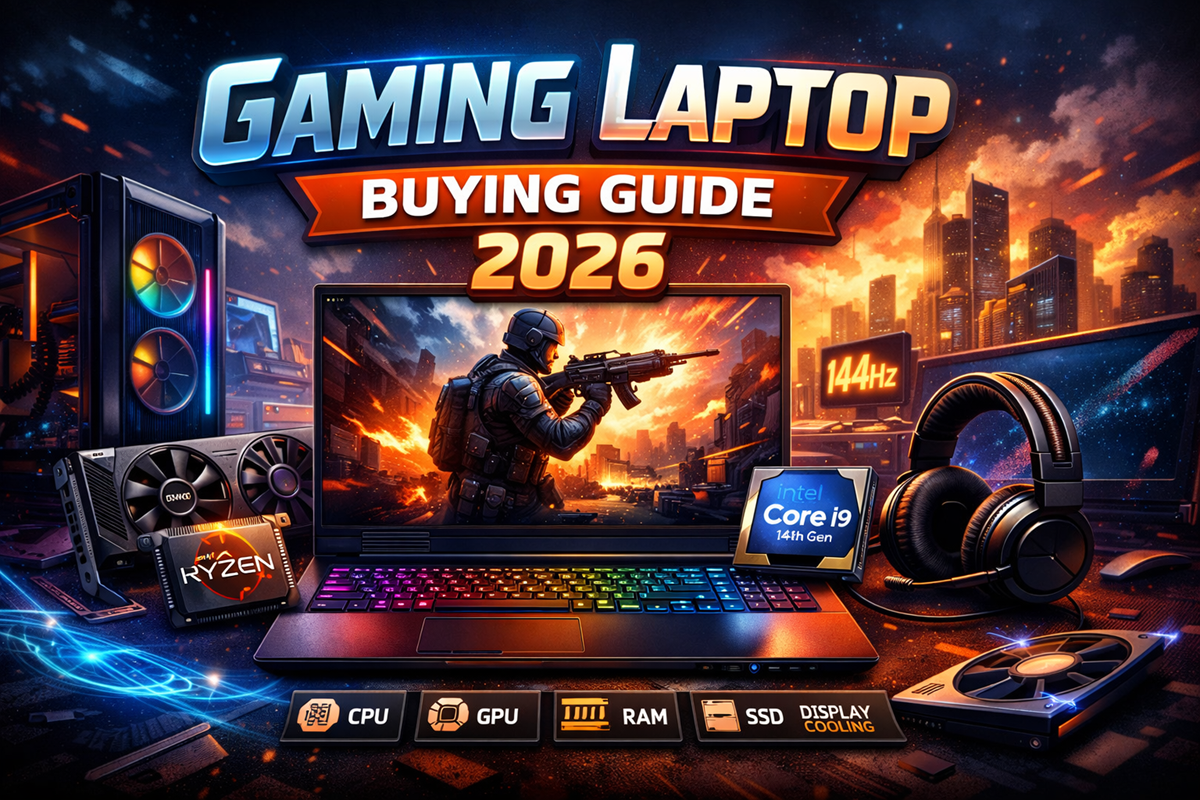
Powerful GPU and CPU Ample RAM 16GB Fast SSD storage High refresh rate display 120Hz Efficient cooling system Robust build quality Good keyboard and trackpad Long battery life consideration Future proofing with upgradeable components
35

Best Gaming Laptops At CES 2026 RTX 5090 Options Dual Screen Picks Lenovo Legion Pro Rollable Concept. Top 5 Laptop Gaming Ng Mua Nh T 2026 K Nguy N AI PC RTX 50 Series Gemini Generated Image . Best Gaming Laptop 2026 Top Picks For Every Budget Best Gaming Laptop 2026 . Best Gaming Laptops 2026 Top 10 Picks By Budget Performance What Are The Best Laptops For Gaming In 2024 400x225 . Best Gaming Laptop 2026 Power Speed Immersive Performance Best Gaming Laptop 2026



Best Gaming Laptops For Every Type Of Gamer In 2026. Gaming Laptop Buying Guide 2026 Complete Buyer S Guide Gaming Laptop Buying Guide 2026 . The Best Cheap Gaming Laptops For 2026 Tested For Gaming Top 3 Gaming Laptops Of 2026 - The Ultimate Guide . Best Gaming Laptops In 2026 Life Style Tech And Digital Whisk 1024x559 . CES 2026 Asus ROG Zephyrus Duo Is Finally A Proper Dual Screen Gaming Hero

Gaming Laptops Are They Truly Worth It In 2024 Gaming Laptops . 2026 Gaming Laptop Displays Design Battery Life The Complete Buyer 5.1 1 . The Ultimate Buying Guide To Gaming Laptops 2026 Sourav Joshi Vlogs Best Gaming Laptops 2026 . Best Gaming Laptops 2026 Top 5 Picks With RTX 50 GPUs Price Comparison Top 5 Gaming Laptops In 2026. Lenovo S CES 2026 Concept Laptops A Rollable OLED Gaming Beast And A Lenovo CES 2026 Rollable Laptop Concepts 20260107 103129


What Gaming Laptops NEED To Get Right In 2026 YouTube . Top 10 Best Gaming Laptops To Buy In 2026 Power Performance What S . Best Gaming Laptops For Every Type Of Gamer In 2026 Blog.webp. Best Gaming Laptop 2026 Real World Picks I D Actually Buy Gamer Org A Sleek Tech Thumbnail Design Featuring 780x438 . How To Choose The Right Gaming Laptop 2026 What You Need To Know WIRED The Ultimate Quest How To Choose The Right Gaming Laptop



The Complete List Of GeForce GPU Power For 2025 ROG And. Best High End Gaming Laptops For Smooth Gameplay 2026. Best Gaming Laptops For Every Type Of Gamer In 2026 Social.webp. Las Mejores Laptops Gamer De 2026 Gu A Para Elegir Best Laptop Ever . Best Laptops 2026 Top Picks For Every Budget Use Case Xthe Best Laptops 2026 Top Picks For Every Budget Use Case 750x350


Intel S Panther Lake Could Power New Gaming Handhelds In 2026 Windows . Dell Unveils Ultra Slim And Entry Level Alienware Gaming Laptops At CES Alienware 38e863a74e . CES 2026 Lenovo Brings Out 16 To 24 Expandable Gaming Laptop Ces 2026 Lenovo Brings Out 16 To 24 Expandable Gaming Laptop Techjuice 211204 062816 . BEST GAMING LAPTOPS IN 2026 REVIEWED AND RANKED Technical 1200 80 . What Specs Do You Need For A Gaming PC In 2026 PC Build Experts Pexels Ron Lach 7858742 300x200

Top 10 Gaming Laptops Of 2026 Unleash Next Level Power YouTube . 8 Best Gaming PCs For 2026 Ultimate Buyer S Guide Best Gaming Pc 2026 The Neuralcore X.webp. 2026 Gaming Laptop Guide New CPUs GPUs And The Laptops Worth Waiting 2026 Gaming Laptop Guide Cpu Gpu Models.webp. Best Budget Gaming Laptops 2026 Top Value Picks Best Budget Laptops For Gaming 2026 1024x600 . Laptop Buying Guide 2026 Top Features And Trends Geeky Gadgets Laptop